


Updated January 2026
Classical homeschool Morning Time is a short, shared part of the day where we gather to read, sing, pray, and learn together before separating into individual work. It is not a full school day, and it is not meant to cover every subject. Its purpose is formation and culture-building.
In our homeschool, Morning Time has been the anchor of the day from the early years. It creates shared culture, establishes habits of attention, and gives our days a calm, predictable start. When Morning Time happens, the rest of the day tends to go better, even when plans change or lessons take longer than expected.
This post explains what Morning Time is, why it matters in a classical homeschool, and what it has looked like in our family. The details have shifted over the years as our children grew, but the structure has remained remarkably stable. Short lessons, repeated often, have proven far more effective than ambitious plans that are difficult to sustain.
If you’re new to homeschooling, Morning Time can feel mysterious or intimidating. If you’ve been homeschooling for a while, it may feel like something you should be doing “better.” My goal here is to clarify the purpose of Morning Time and show how it can be simple, flexible, and genuinely helpful—without becoming another thing to manage or perfect.
Why Morning Time matters in a classical homeschool
Way back when when my oldest was in preschool, I was reading Cindy Rollins’ blog, where she continually told us that Morning Time was the best thing she did in her homeschool. I took her advice to heart and stepped out in faith that she was on to something.
As she shared about Morning Time, it reminded me of the Bible Time my mom did when she began homeschooling. We’d sing, practice memory verses, and read the Bible together as the first part of the day. I didn’t remember much of my own early years of being homeschooled, but I remember singing Holy, Holy, Holy and Fairest Lord Jesus.
When I was a little older, we sometimes did family devotions. We’d each get to choose a hymn to sing (and so developed favorites), we’d recite and memorize catechism and Scripture, and sometimes work through a book or just read Scripture.
Without a doubt, it is because of those times that I can sing dozens of hymns from memory and although I wouldn’t get a lot of accuracy reciting Scripture, I went into adulthood familiar with it.
I wanted that experience developed more, taken to the next level, for my own children, and Morning Time sounded exactly like what I wanted. It was a reserved time to practice those things that mattered more than even the math facts.
Over ten years later, I agree with her assessment of Morning Time, as well. Although we’ve been shaky in our consistency, it’s been the soil and watering that has allowed deep roots to grow and fruit to flourish.
Her description of starting the day together singing and doing the beautiful things that are so easy set aside in favor of the workbooks resonated with me.
I knew that having that time set aside for learning hymns, catechism, and Scripture would bear fruit if we stuck with it through those daily little moments that don’t feel like much.
“That is what Morning Time is. It is the daily collection of little grains of time that add up to a lifetime of learning. It is the daily sowing of the seeds of learning for the long haul. Morning Time is not about reaping a quick harvest of spinach or lettuce after a few cool weeks.
“Morning Time is about faithfully tending an orchard over long, long years knowing that the future harvest will be far more valuable than any quick crop. Maybe it isn’t even an orchard-this is homeschool carbon which will produce a harvest of diamonds for those who have the patience and the courage to go for the long prize.”
Cindy Rollins
Because my own journey into Morning Time was aided so much by Cindy Rollins, Kendra Fletcher, and others who shared their memory lists and ideas, I too want to share our resources for those just beginning. Here you will find what we’ve done over the years as well as advice for sticking it out through the difficult stages.
A Scheduled Spot for Happiness
Morning Time ought to be the happiest part of our homeschool day.
But what is happiness, really?
That’s actually a deep philosophical question expounded upon by great minds for millennia.
Too often, we think happiness is doing what we want, having no laundry to fold, or eating chocolate.
And our kids think happiness is sleeping in, playing computer games, and having no chores.
Guess what? We’re both wrong.
If that’s your idea of happiness, make sure your goal is not to keep your kids happy.
Then again, we can’t say happiness doesn’t matter.
Surely we’ve all had homeschool days with sadness, anger, and frustration.
We don’t want that to be the norm, either.
Don’t give up on happiness, just think bigger about what happiness is and where it comes from.
Let’s be classical in our approach to happiness as well as our approach to education.
“Happiness then, is found to be something perfect and self sufficient, being the end to which our actions are directed.”Aristotle
We aren’t actually made happy by entertainment or temporary pleasure. True happiness is found in what is lasting: God’s glory and enjoying that forever. And we can only enjoy God’s glory when our hearts are tuned to love His law more than our own whims – and that state is often called virtue.
“He is happy who lives in accordance with complete virtue.”Aristotle
Virtue doesn’t come easily to us, and neither, therefore, does happiness. Our temptation – ours and our children’s – is that we equate happiness with ease.
Happiness, however, is for the one who has learned to overcome his in-the-moment cravings for something better, something higher.
In our homeschools, we’re helping our children see that and choose that. Goodness, we also as the mothers are learning to do so more and more.
We’re giving the kids practice – and taking practice ourselves – in denying momentary pleasure for the sake of more lasting pleasure, whether that be knowledge, skill, or relationship. All of these grow us in wisdom, which Scripture tells us to value more than gold. And all of these point us to worship and increase our capacity for worship – the more we know and understand God & the world He made, the better worshippers we can be.
St Augustine defines virtue as ordo amoris, the ordinate condition of the affections in which every object is accorded that kind of degree of love which is appropriate to it. Aristotle says that the aim of education is to make the pupil like and dislike what he ought.
“When the age for reflective thought comes, the pupil who has been thus trained in ordinate affections or ‘just sentiments’ will easily find the first principles in Ethics; but to the corrupt man they will never be visible at all and he can make no progress in that science.
“Plato before him had said the same. The little human animal will not at first have the right responses. It must be trained to feel pleasure, liking, disgust, and hatred at those things which really are pleasant, likeable, disgusting and hateful.”
C.S. Lewis
Augustine, Aristotle, Plato, & Lewis in one? Surely we must pay attention.
Our school days are about shaping tastes and growing loves.
And there is no more potent time to do that than in Morning Time.
“Where your pleasure is, there is your treasure: where your treasure, there your heart; where your heart, there your happiness.”
Augustine
So why the discourse on happiness and virtue in a planning post? Because principles apply to our practices. We don’t hold principles and beliefs in our heads, then do whatever seems most convenient – that’s hypocrisy.
I need my focus on the why behind what we’re doing so it doesn’t turn into going through the motions – and so that I don’t skip it because I’ve lost my vision. Some hold on to routine after the vision is gone, but I’m more likely to chuck it over entirely (which looks like remaining sitting with my coffee) the moment the vision begins to fade.
So I write to keep it fresh and lively in my own mind.
The longer I homeschool, the more I believe that how you begin the day sets the tone for the rest of the day. So that means our mornings matter most. Whenever your days begin, we face our most crucial moment. Starting is already the hardest part, but on top of that it’s also the most vital part, the most influential part of the day.
Some of my children have different ideas than I do about what a good start looks and feels like.
I like the coffee and pep and rev your engines sort of start. If the morning drags, I feel draggy all day.
But others are slow-starters who need some time and space to ease into their day and not feel jumped on or shoved along.
And yet those same children still want to be done with school by lunch time.
So, we have to find a way to get us all on board, together, on time, in a way that moves us into the school day ready and engaged.
And that means Morning Time.
It is both beginning the plan for the day and a gentle start. It feeds the spirit and its pace is brisk. It brings us together into unity (I almost said harmony but we’re not that accomplished in our singing yet). It ensures we start with prayer. It ensures the most important things are first and done.
So Morning Time, this year, comes before anyone is allowed to see their math pages or start any other work, other than piano practice. I don’t want to tear people away from their work for Morning Time, and I don’t want the sight of math to be done to tank moods before we’ve begun.
To ensure that everyone is grounded, together, and Scripture-soaked first thing, Morning Time will start our days – before math.
“Happy work is best done by the man who takes his long-term plans somewhat lightly and works from moment to moment ‘as to the Lord.’ “C.S. Lewis
If Morning Time is not – generally speaking – increasing our love of each other, God, and the day’s work – it’s not doing its job. The memory work is only a tool, not a goal.
Morning Time, or Circle Time at our house, is the very heart of our homeschool practices. Every morning we come together and recite beautiful words and beautiful truths together, centering our day and work on Truth, Goodness, and Beauty from the beginning.
We’ve been doing Circle Time from the time my oldest was 5, over 7 years ago. It’s evolved and grown over the years, but it’s remained the essential ingredient that has kept us focused on what’s truly important.
Even when we know that Circle Time, Morning Time, is the best part of our day, the temptations to skip it abound. Whenever I am in planning mode, I am always determined to emphasize Morning Time. But when a midweek school day begins, all the reasons why we probably shouldn’t sit down and do it crowd my mind.
The truth is, Morning Time takes a lot of presence of mind, and I usually resist giving my entire presence of mind to our school day – which is not good at all. It is another reason why Morning Time is a good practice for me. I repent of my preference to simply shuffle everyone off to work on their own, gird up the loins of my mind and my attitude, and determine to start the school day off on the right foot.
In Morning Time almost more than any other point in our school day, if Mama’s got a stinky or lethargic attitude, everyone’s got a stinky or lethargic attitude. So I must muster the same response I want to require of my children when I call them to Morning Time.
And that’s why coffee should be an indispensable part of the routine.
Here are three tricks I’ve found to help muster my own energy:
- Teach the children to come to the table in response to an alarm or bell. Make the calling everyone together simpler and not requiring shouting and calling and herding and cajoling. If I can simply shake a bell and people come get their binders, the hurdle to begin is easier (it’s easy to ring a bell, hard to go search out and round up five children).
- Have a policy of no technology checking during Circle Time, or even after breakfast. One thing that delays Morning Time is when I get on my computer when I should be directing children and getting us all going on our business of the day. If, after breakfast, I close the laptop, we’re about 1000% more likely to start school and Morning Time on time.
- Start with a piece that everyone enjoys. It’s easier to get going if you know the first thing you have to do is something that will be an “easy sell” to the children. Build up to the parts that require more of them, don’t start off with the most demanding pieces. Get them on board first with a fun chant, a song, a call-and-response, a greeting ritual, listening to a chapter from Proverbs or a Bible story – something that will bring a smile to each face first thing. That smile is the momentum that will help you all carry through the rest.
Why We Prioritize Morning Time
Way back when when my oldest was in preschool, I was reading Cindy Rollins’ blog and took her advice to heart and stepped out in faith that she was on to something. Her description of starting the day together singing and doing the beautiful things that are so easy set aside in favor of the workbooks resonated with me. It reminded me of the family devotions my own family did sporadically while I was growing up, and I knew that having that time set aside for learning hymns, catechism, and Scripture would bear fruit if we stuck with it through those daily little moments that don’t feel like much.
After seven years of starting at least half our school days with Morning Time, every year I only prioritize it more and more as I see it bear fruit, slowly but surely.
My favorite small fruit is the two-year-old singing our current hymn in her nap-time crib. But I know without this time set aside for what is true, good, and beautiful, we would not have learned the catechism, would not have so many hymns available in our minds to hum, would not have phrases of Scripture familiar on our tongues (even if we can’t recite them word-perfectly). It would be too easy – it even is still too easy – to default to doing the math page, assigning the reading, and calling that school. And perhaps that would be school, but it would not be a life.
Morning Time is the part of the day that builds our family culture and weaves us together as we meditate on truth and let it sink down into our bones through sheer, stubborn repetition.
Why I Call Our Morning Time ‘Classical’
No, you do not need to choose classical education to do a Morning Time. Morning Time is not specifically classical. It fits with any style of homeschooling and what you do during it can be customized to fit your own particular family culture. It is simply taking advantage of the chief good of homeschooling: pulling all the family together to learn alongside one another, multiple ages, good days and bad, building a network of shared family knowledge and experience.
My working definition of ‘classical,’ however, would probably encompass your Morning Time as classical even if you don’t want the label. I believe classical refers not ultimately to studying Latin (though we do) or having a literary core (which we do), but to the aim of what we are doing, which is virtue.
Educators from Aristotle and Plato, on to Augustine and Anselm, even unto Luther, Kuyper, and Charlotte Mason, saw the entire point of education not to get a job or become a productive worker bee in the economy (that’s a modern Marxist paradigm), but to become a fully human person who both knows truth and practices truth.
Morning Time is, at heart, a time to learn truth (through singing, Scripture, catechism, and other wise words) beautifully, pre-critically, in harmony with others, so that it seeps into our minds and bones and gradually works itself out in our affections, choices, and actions.
So your Morning Time is probably classical, too, even if you don’t consider yourself a classical homeschooler.
How to Get Started with Circle Time (or Morning Basket)
“I can barely make it through ‘circle time.’ How long does your Circle Time take each day? Did you start out full force, or have you been adding to it year by year? Could you write an article about Circle Time? Could you include more of your planned circle times? I find myself just wanting to grab things from your plan, because it is SO much like what we do!”email from Meg in 2014
Our Circle Time – or Morning Time – has definitely grown over the years. The plans I am now putting together are our seventh or eighth (eighth if you count spending 5-10 minutes a day (sometimes even done in the car) learning the Children’s catechism, Holy Holy Holy, and Psalm 1 at 4 & 2 – and why would that not count?.
The majority of our Circle Time is spent on reviewing previous materials, so that is how our time together has naturally expanded.
Here is our progression over the years (grade is that of my oldest):
- PreK (2007) – Psalm 1, questions 1-20 of Children’s Catechism, and Holy Holy Holy
- K (2008) – Psalm 1, Ephesians 6:1-3, and The 10 Commandments (that didn’t go well), questions 1-50 of the Children’s Catechism, Holy Holy Holy, A Mighty Fortress, and For All the Saints.
- 1st (2009) – I added one more passage (and actually replaced the 10 Commandments), all the Children’s Catechism, the Apostles’ Creed, and another hymn, so that we had one per day (we did CT four times a week).
- 2nd (2010) – I think this was the year I incorporated our term structure, so I had new material every 6 weeks and had a review section in my binder where we daily reviewed one passage (maybe a hymn?) and just rotated through them with a sticky tab marking the spot. After a term, that term’s passage went into the review section.
- 3rd (2011) – I think this was the year I added poetry memory and also first made the oldest two their own binder. I added new material each term and added the previous material into regular review. For both 2nd & 3rd grade I took most of my ideas for what to pick from Brandy’s and Cindy’s lists.
- 4th (2012) – Starting this year, I also began keeping a note when I’d read a passage I thought would be good to memorize or when we sang a hymn at church that I wanted to add. Now I get my memorization ideas from that ongoing list. I improved our binders to the system I am still using and loving.
- 5th (2013) – Hans & Jaeger got to choose half their own poems this year and we worked on learning the entire book of Ephesians (we read a chapter aloud daily and we’ll still continue with it the next year).
- 6th (2014) – Hans & Jaeger each picked all 6 of their poems for the year. We’ll focus on reinforcing Ephesians and on learning the Ten Commandments and the Catechism questions that explain them.
Some people use Circle Time to do read alouds, to do art or composer study, or to do other group lessons. For us, however, Circle Time is exclusively memory work (with singing and prayer, as well). It’s our way to start our day off on the right foot: with prayer, song, Scripture, and beautiful language. That’s the beauty of Circle Time: It can be whatever fits your family and season of life right now. There is no Right Way to do it. Take the ideas that inspire you, keep it as simple as you can, and just do it daily.
Circle Time’s primary function is to bring the family together and create a family atmosphere and culture around truth, goodness, and beauty.
Start Small. Keep It Simple.
Circle Time doesn’t have to be a huge production, and it doesn’t have to take an hour or more.
Circle Time is best when everyone is on board and cooperating at least 80% of the time. If it’s less than that, it’s better to chuck what’s causing contention than to hold on to it and have conflict every morning. It’s better to have a 15 minute happy time together than an hour of fighting. Believe me, we’ve had those days and I had to let go of what I read was the Best Way in order to find what made it a Happy Way for us.
Remember the point is relationship-building, culture-building, and affection-building. That’s why you shouldn’t do more than you (and your children) can do cheerfully.
But do stick in a small bit of something you (or your children) don’t naturally like, but that you know you should. Familiarity breeds affection, not contempt. If you want to grow to love poetry, or the catechism, or singing, or Scripture itself, then the best way is simply to do it a little bit every day, in amounts that don’t wear you down. Knowledge, familiarity, and skill build affection, and those all come through daily encounters.
Don’t despise the day of small beginnings. One hymn, one Psalm, and one poem might seem like an insignificant start, but an insignificant start is better than no start at all. In six years you will be shocked at how far you’ve come if you stick with small changes. Festina lente.
Morning Time with Babies and Toddlers
How things flow and what is included in our Morning Time has changed every year, and often there are tweaks or even major alterations midyear.
Particularly in the stage of the game where new people are being added to the family, where babies change their habits every three months, where toddlers come and go and come again, and where more children can’t read than can, Morning Time sanity can be touch and go.
There’s no “right” way for it; remember that. Having time together to pray and sing and do some Scripture memory is really the important part, and everything else (and how it happens and how it flows) is incidental.
For awhile, I recorded all our memory work and played the tracks for us all to recite to, because then my attention could be directed at babies, toddlers, and miscreants. Sometimes we only colored while listening. That was after a particularly rough bout where it was pulling teeth to get my oldest as a 5-year-old to repeat after me. It was a power struggle that made me a frazzled and not-nice mommy.
So much for “best part of the day.” I changed the tactics on him and won. I decided exposure and enjoying the time was more important than having it happen the way other people said to do it.
Give yourself that freedom to be unconventional and do what works. Most likely, you’ll need a brand new plan in 6 months or a year anyway. How you do it now doesn’t have to be how you do it forever.
When Morning Time Is a Mess
I think it was our second year of school and Circle Time and I remember “Best Part of Your Day” being a phrase that stuck in my mind.
Because it definitely wasn’t.
Quiet time was definitely the best part of the day, and I’m not talking about early morning devotions.
Circle Time was like the refining fire that brought out all our impurities.
No one could sit still (though they did perfectly well sitting for dinner and for church), half the time at least half the “participating” (I use the word loosely) children (at that time half would be one) were uncooperative, and my oldest and I spent much of the time vying for control of the situation and routine.
Repeating catechism or Bible verse lines after me was more often than not physically impossible and almost every aspect of the entire half hour (often dragged on for an hour or more) seemed to bring out the worst in us all. My oldest isn’t strong willed – except for during Circle Time.
It clearly was good for us.
Between Kendra and Cindy touting it as the best thing ever, I wasn’t going to give up easily, and I was determined to win any parent-child battle-of-the-wills (strategically, of course, not by brute force: outlast and stay in charge).
Finally, this year, the crop is starting to bear fruit.
I attribute it to these factors:
- I finally won the “this is how it is and will be” contest. It only took 3 years. Talk about outlasting.
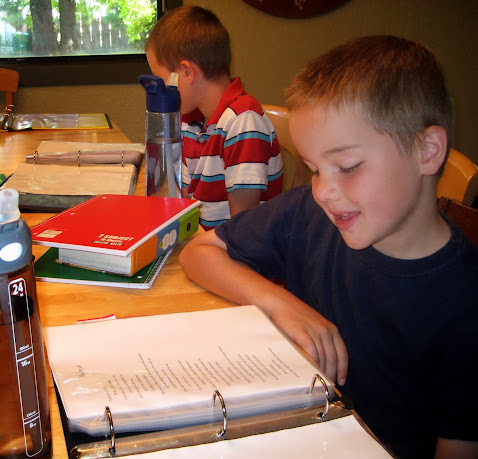
- I eliminated the main source of friction (repeating after me) and changed the atmosphere to one of we’re-each-a-part-of-this-together instead of I’m-in-charge-here by giving each of the children their own binder and us all reading aloud together (or alternating individually — I still shake things up to keep them flexible). This wasn’t possible until I had readers.
- I now have 2 fluent readers and more mature students to carry the thing and I have it set up in such a way (each with his own binder, reading/reciting) that the preschooler, the toddler, and the baby can’t derail it. Now my older two are experienced, adept, and habituated enough to keep going even if I have to walk out with a toddler, stop to correct a preschooler (they don’t stop), or comfort a famished infant. Now, even if half the students are misbehaving (and half is now 2), the other 2 can keep it running (and doing so helps them feel in charge and responsible, which is what they weren’t feeling when they had to only and constantly follow and obey commands).
So, if you are in the midst of that Circle-Time-as-Chaos phase, be encouraged.
It might take 3 years to overcome, but it’s worth it. Those early years without older kids is just flat difficult. Change things up, problem solve, get creative, and persevere. Those little ones will be your leaders in just a few short years and be your assets that will make maintaining much easier with the next round of chaos.
I still have a temperamental 5 year old. I have the most chaos-inducing toddler of them all. I have a newborn who is no respecter of schedules or school times. But I have two fluent readers who can still carry the show if they stay on board and if I captain cheerfully.
The 5 year old can participate or not as she deems. She doesn’t make or break us (when it was just a 7 year old and 5 year old, the 5 year old could make or break it). She is still hearing it all and it’s soaking in whether she likes it or not. She’s still catching it, even if she thinks she’s refusing it.

The toddler can (and does) fuss and get in and out of his chair and interrupt and otherwise make hay. We soldier on, ignoring most of his antics. And, he can be banished, and we can still go on; he’s already learned he’d rather stick around be a part of this family culture thing than be solitary in his room while we’re singing and declaiming. And, for our part, we want him, too. So we’re willing to speak up and put up with his activity. He sits for dinner, when Dad reads the Bible aloud, and for church. He doesn’t have to sit still for Circle Time.
When one reader puts up protests, the other is quick to step up and take over, which provokes the would-be-mutineer to either buck up and continue pulling his load or risk banishment.
The only thing that can really derail us now is my own attitude and my own responses. So, we still have plenty of trouble.
But, in our fourth year, the thing is that we all really, truly enjoy Circle Time when we are all in fellowship.
Singing together is very bonding. It is also mood-lifting. I don’t think you can stay a mean and upset mom while also singing a hymn with your children. Often, bad attitudes all around melt during the opening hymn. Thus, singing is now sprinkled throughout Circle Time: beginning, middle, and end.
My readers are not getting the skill of careful listening and duplicating nor of precise rote memorization. But they are gaining skills in inflected, well-articulated reading and in fluent hearing, reading, and understanding long paragraphs of good, strong English (without it being broken up by phrase or sentence).
Every day or once a week, we hear the same Psalms over and over, and the phrases flow over us, softening and shaping. Every day or once a week, we say aloud the same New Testament paragraphs, not separating the application verses from the doctrine or doxology verses, but letting the whole connected thought pound its way in day after day.
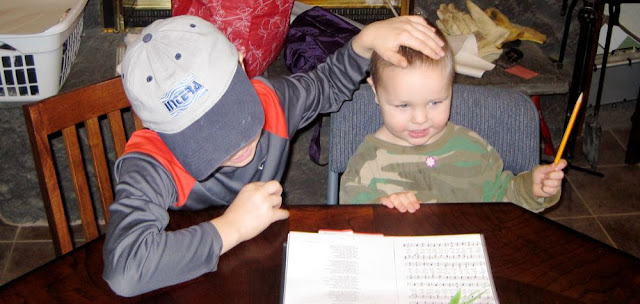
Now, at last, our Circle Time really does resemble a circle with us all around a table. And we all sing together, we all read aloud familiar Bible passages together, we echo catechisms and mottos and creeds. And, even in the daily messiness and craziness, it is the true blessing of a family unity and a family culture being birthed.
Yes, in fact, it is like birth. In that moment, it’s all pain and overwhelming work. No one (in their right mind) wants to go through labor and birth. But we all want that little person that comes after all the trouble.
In its own little way, Circle Time is a labor and a trouble. It still often is. But it’s worth it in the end. And, in those precious moments in the midst of it where the glimpses of perspective are granted, it’s beautiful even in the midst of it.
How we practice and review memory work
For many years we used memory work binders. Every reader had the exact same pages in the exact same order, with tabs between sections. We’d typically do one page per section and move a Post-it flag to the next page to keep track of where we were in each section. Here are some video tours of our memory work binders:
Simply Charlotte Mason’s Scripture memory system is a popular resource for a reason. It’s a great way to organize your memory work not only to learn it by repetition, but also to retain it by repetition. It’s so easy for previously learned work to fall by the wayside because it isn’t reviewed. And, as John Milton Gregory writes in The Seven Laws of Teaching, “No time is wasted, which is spent in review.”
Rather than use index cards and boxes, I made up a binder with a similar set up for our Circle Time. Well, I made up 4 binders. One for me, and one for each reader (or, soon-to-be reader who wants to follow along).
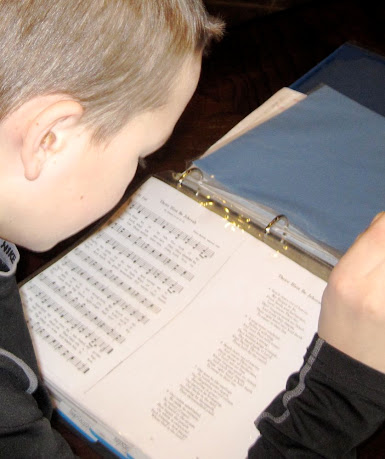
Is putting the words we are memorizing in front of the readers “cheating”? It is accessing a different sort of memory than having to learn strictly through oral repetition, but I’m ok with that.
My readers are not getting the skill of careful listening and duplicating nor of precise rote memorization. But they are gaining skills in inflected, well-articulated reading and in fluent hearing, reading, and understanding long paragraphs of good, strong English (without it being broken up by phrase or sentence). Every day or once a week, we hear the same Psalms over and over, and the phrases flow over us, softening and shaping. Every day or once a week, we say aloud the same New Testament paragraphs, not separating the application verses from the doctrine or doxology verses, but letting the whole connected thought pound its way in day after day.
I like this set up because
- It has reduced friction and battle-of-wills between my sons and me.
- It makes it easier and smoother to work on entire chapters of Scripture at a time.
- It helps the flow of Circle Time continue even if I am distracted by or absent because of babies or toddlers.
- I believe it is helping my readers’ spelling naturally and visually, as they both say and see hundreds of words daily. We don’t do spelling as a separate subject, and they have few misspelled words when they write.
- I love hearing the 3-year-old use phrases from Psalms or the catechism and tunes from hymns in his playing.
- I think slowly reading through a large chunk of Scripture, or a poem, or a beautifully written catechism answer (the Heidelberg is beautiful while also being succinct; I love it) is a great way to meditate on things that are lovely. Circle Time is for myself as well as the children. Even if I end up missing my own personal devotions in the morning, we spend an hour together praying, singing, reading together 2 Psalms, a chapter of Ephesians, and 2-3 other shorter paragraphs of Scripture, as well as reading grounding, comforting catechism answers.
To keep track of what sections we have and what memory work we would add each term, I used tables. Here’s a video tour of my Morning Time plans from 2015:
We do not worry about memorizing our memory work.
Rather than pursuing perfect recitation (which will likely not last past their childhood), I’m seeking more to begin and set their deep foundation that will be continually and cyclically renewed and built upon throughout their lives. I want familiarity, language patterns, and ideas to seep in.
I am not a meticulous person — I am more a hack — we recite one passage and one Psalm daily for one term (6 weeks), whether it’s memorized in 2 weeks or not memorized yet by the end. Usually it is memorized or pretty close by 4 or 5 weeks, depending on the length and our consistency.
Then, for better or for worse, it is replaced by the next term’s passage and Psalm and it moves into the review tab, where it gets hit when we get to it. After a week or two without saying it daily, usually the boys cannot recite it as well as they had by the end of the term. But because my goal is building a lifetime of familiarity rather than perfect rote memory, this no longer frustrates me.
This is my own personal “good enough” and “works for us,” because my priority is on keeping it simple, no-pressure, and about exposure, familiarity, and whole-idea rather than perfect articulation. There is a place for that, and if you can achieve that without stress and it’s working for you, then keep it and run with it!
However, if memory work has been a stressful thing, don’t give it up! Just pare it back, remove the pressure and expectations, and remember that God’s Word is active and will bear fruit — getting it to them (and us!) and in them (and us!) is what counts. Also, perfectly articulated memory is easily and quickly lost if not reviewed constantly, as I know well from all I memorized week-to-week when I was young, having little to show for it a few months later. Even so, it was a foundation of familiarity that was not unfruitful.
Bible Memory Work Selections
Passages that are bolded are the ones we emphasize in review so the younger crowd picks them up, and are the ones I would start with if we were doing it over from the beginning.
Psalms
- 1
- 8
- 15
- 16
- 19
- 20
- 23
- 24
- 25
- 29
- 32
- 33
- 34
- 37
- 42
- 46
- 92
- 97
- 98
- 100
- 107
- 110
- 112
- 115
- 116
- 121
- 139
- 145
- 150
Proverbs
- 3:1-12
- 6:6-11
- 6:16-19
- 9:7-10
- 10:9
- 10:12-14
- 10:19-21
- 10:23
- 11:17
- 11:23-25
- 12:1
- 12:16
- 12:22
- 15:1
- 19:5
- 19:11
- 20:11
- 21:25-26
- 26:20
Passages
- Lamentations 3:21-40
- Habakkuk 3:17-19
- Micah 6:6-8
- Matthew 5:2-16
- Matthew 6:5-13
- Matthew 22:37-40
- John 1:1-5 & 9-14
- John 3:14-18
- Romans 8:1-4, 26-39
- Romans 10:9-11
- 1 Corinthians 10:12-13
- 1 Corinthians 13
- 1 Corinthians 15:3-4
- Galatians 5:22-26
- Galatians 6:7-10
- Ephesians 4:25-32
- Ephesians 6:1-3
- Philippians 4:4-9
- Colossians 1:9-23
- Colossians 3:1-4, 12-17
- 1 Thessalonians 5:12-24
- 2 Thessalonians 2:13-15
- 2 Thessalonians 3:7-16
- 2 Timothy 2:3-7
- 2 Timothy 2:20-26
- 2 Tim. 3:14-17
- 1 Timothy 6:3-16
- Hebrews 2:14-18
- Hebrews 4:12-16
- Hebrews 11:1-16
- Hebrews 11:1-6
- 1 Peter 1:3-19
- 1 Peter 3:8-17
- Titus 2:11-3:9
- 1 John 1:5-9
Hymns to Memorize in Your Homeschool
The primary goal I have for our hymn-learning, and therefore how I make most of my choices, is that the children learn hymns we sing regularly at church so that they can participate better in worship.
We also regularly sing together the service music (Doxology & Gloria Patri). I absolutely love hearing my 2-year-old sing the Doxology in his crib — all of my 2-year-olds have, and it is a blessing.
Bolded hymns are the ones we repeat most so the youngest children learn them, too. All numbers are from the Trinity Psalter Hymnal.
- All Glory, Laud, and Honor (325)
- All Hail the Power of Jesus’ Name (374)
- Amazing Grace (433)
- And Can It Be That I Should Gain (431)
- At the Name of Jesus (270)
- Be Thou My Vision (446)
- Christ Shall Have Dominion (421)
- Christ Whose Glories Fill the Sky (156)
- The Church’s One Foundation (404)
- Come, Thou Almighty King (428)
- Come Thou Fount of Every Blessing (429)
- Crown Him with Many Crowns (380)
- For All the Saints (408)
- Glorious Things of Thee Are Spoken (403)
- Great Is Thy Faithfulness (245)
- The God of Abraham Praise ()
- God Himself Is with Us (164)
- God Moves in a Mysterious Way (256)
- Guide Me O Thou Great Jehovah (524)
- Have Thine Own Way, Lord (533)
- Holy, Holy, Holy (230)
- How Vast the Benefits Divine (426)
- I Sought the Lord, and Afterward I Knew (427)
- Immortal, Invisible, God Only Wise (224)
- It Is Well (476)
- Jesus, I Am Resting, Resting (479)
- Jesus Paid It All (276)
- Jesus Shall Reign Where’er the Sun (417)
- Jesus, What a Friend for Sinners (456)
- Lead On, O King Eternal (544)
- May the Mind of Christ, My Savior (488)
- A Mighty Fortress is Our God (244)
- Not What My Hands Have Done (435)
- Nothing But the Blood of Jesus (278)
- O For a Thousand Tongues to Sing (291)
- O the Deep, Deep, Love of Jesus (463)
- O Worship the King, All-Glorious Above (219)
- Praise the Savior (335)
- Praise to the Lord, the Almighty (216)
- Rejoice, the Lord is King (281)
- Rock of Ages, Cleft for Me (452)
- Savior Like a Shepherd Lead Us (525)
- Shout for the Blessed Jesus Reigns (411)
- Take My Life and Let It Be (538)
- This is My Father’s World (PH 374)
Psalms to Sing
- That Man Is Blest (1A)
- Lord, Our Lord Thy Glorious Name (8C)
- Wholehearted Thanksgiving (9B)
- The Fool Speaks in His Heart (14)
- Amid the Thronging Worshippers (22C)
- The Ends of All the Earth Shall Hear (22D)
- Now Unto Jehovah (29B)
- How Blest Is He Whose Trespass (32B)
- I Waited for the Lord (40B)
- As the Deer (42A)
- O Lord of Hosts, How Lovely (84C)
- Now with Joyful Exultation (95C)
- O Sing a New Song to the Lord (98A)
- The Lord God Reigns in Majesty (99B)
- All People that on Earth Do Dwell (100B)
- O Come, My Soul, Bless Thou the Lord (103E)
- The Glorious Gates of Righteousness (118B)
- How Shall the Young (119B)
- Let Israel Now Say in Thankfulness (124)
- From Heaven O Praise the Lord (148A)
- Hallelujah Praise Jehovah (148B)
Creeds & Catechism Memory Work
We generally start off our memory work time by reciting together a creed. I have three we alternate between:
Catechism for Young Children
We memorize and regularly rotate for review the Catechism for Young Children, with all 145 questions. You can find the full version here.
Selections from the Heidelberg Catechism
- Lord’s Day 1 — What is your only comfort in life and in death? Q2: What must you know to live and die in the joy of this comfort?
- LD 5, Q12 — According to God’s righteous judgment, we deserve punishment both in this world and forever after: How then can we escape this punishment and return to God’s favor?
- LD 7, Q13 — What is true faith?
- LD 10, Q27 — What do you understand by the providence of God? (another of my favorites)
- LD 12, Q32 — But why are you called a Christian?
- LD 23, Q60 — How are you right with God?
- LD 25, Q66 — What are sacraments?
- LD 30, Q81 — Who are to come to the Lord’s Table?
- LD 32, Q86 — We have been delivered from our misery by God’s grace alone through Christ and not because we earned it: Why then must we still do good?
- LD 45, Q116 — Why do Christians need to pray?
Poems to Memorize (by grade)
Poetry is a wonderful component to add to our homeschools, though those of us unfamiliar with it might be unnecessarily intimidated by it. However, poetry reading and listening develops language patterns, listening skills, and complex thinking ability.
There is perhaps no greater tool than memorization to seal language patterns into a human brain, and there is perhaps nothing more effective than poetry to provide exactly what we want: reliably correct and sophisticated language patterns.Andrew Pudewa
But poetry does not have to be a whole different subject, added in on top of everything. Poetry can be sprinkled into – integrated with – the things we are already doing and even into simply living life.
Here are some simple steps that my family has taken to incorporate poetry into our daily routines:
- Add a poetry book to our read-aloud pile and just read 1 or 2 pages during preschool time. Some of our favorites are Tasha Tudor’s illustrated version of Stevenson’s A Garden of Verses, A Child’s Book of Poems by Gyo Fujikawa and T.S. Elliot’s Book of Practical Cats.
- Find picture books that illustrate one narrative poem as a stand-alone story. The Midnight Ride of Paul Revere, Casey at the Bat, and Stopping by the Woods on a Snowy Evening are some that we have enjoyed.
- Add a poem to our memory work binder. Poems from A Garden of Verses are a great place to start with young children.
- Listen to poetry in the car using A Child’s Introduction to Poetry.
- Sing. We often forget that most hymns and folk songs and other good songs are poetry set to music. In ancient times poetry was almost always recited with musical accompaniment. Don’t discount singing together as a family.
Particularly when the children are elementary and younger, focus on introducing and enjoying poems together. Don’t worry about analysis or interpretation or even comprehension. Just let them experience and enjoy poetry at their own level.
Allow the time and space for love and taste to develop before teaching content and analysis. Then the analysis in later years will be more like sharing thoughts about common friends and less like dissecting a dead frog.
Once a child is 8 or 9, they start to pick some of their own poems, and by the time they are 11 or 12 they pick all their own poems for memory (subject to my own veto, of course). So some of these are not my choices, but they are all poems we’ve learned to love together.
Poetry for Young Children
- Bed in Summer by Robert Louis Stevenson
- Brown and Furry by Christina Rossetti
- The Elephant by Hillaire Belloc
- Good & Bad Children by Robert Louis Stevenson
- Happy Thought by Robert Louis Stevenson
- If Wisdom’s Ways (found in Little House)
- The Land of Counterpane by Robert Louis Stevenson
- Now We Are Six by A.A. Milne
- Marching Song by Robert Louis Stevenson
- My Friend by Lela Birky
- Once I Saw a Little Bird
- Purple Cow by Gelett Burgess
- Summer Sun by Robert Louis Stevenson
- Who Has Seen the Wind? by Christina Rossetti
- The Whole Duty of Children by Robert Louis Stevenson
- Where Go the Boats? by Robert Louis Stevenson
- Windy Nights, Robert Louis Stevenson
- The Wise Old Owl
- The Year’s at the Spring by Robert Browning
Poetry for Elementary Kids
- Bath Song by J.R.R. Tolkien
- Bombadil’s Song by J.R.R. Tolkien
- A Book by Emily Dickenson
- The Boy We Want
- The Bugle Song by Alfred, Lord Tennyson
- Cat Morgan Introduces Himself by T.S. Eliot
- Children’s Song by Rudyard Kipling
- Crack the Plates by JRR Tolkien
- Crossing the Bar
- Daffodils, Wordsworth
- The Duel by Eugene Field
- The Gardener by Robert Louis Stevenson
- The Lamb, Blake
- A Good Play by Robert Louis Stevenson
- If, Rudyard Kipling
- Jim by Hillaire Belloc
- Far Over the Misty Mountains Cold by JRR Tolkien
- Foreign Lands by Robert Louis Stevenson
- Four Things by Henry Van Dyke
- A Pirate Story by Robert Louis Stevenson
- The Proper Addressing of Cats, TS Eliot
- My Shadow by Robert Louis Stevenson
- Song of Drake’s Men by Alfred Noyes (found in My Book House)
- Song of Mr. Toad by Kenneth Grahame
- Stopping by the Woods on a Snowy Evening by Robert Frost
- There Was a Naughty Boy by John Keats
- Tiger, Tiger by Blake
- The Village Blacksmith
Poetry for Middle & Upper Years
- Blow, Bugle, Blow, Tennyson
- The Character of a Happy Life by Henry Wotton
- Charge of the Light Brigade, Tennyson
- Destruction of Sennacherib, Byron
- Dolci et Decorum Est
- Happy the Man by John Dryden
- Henry V before Agincourt by William Shakespeare
- Hymn, Addison
- In Memoriam, Tennyson
- Macavity, the Mystery Cat by T.S. Eliot
- The Man in the Moon by J.R.R. Tolkien
- Not Marble Nor the Guilded Monuments, Shakespeare
- The Patriot by Sir Walter Scott
- The Private of the Bluffs, Doyle
- The Sluggard by Isaac Watts
- To Be a Pilgrim by John Bunyan
- The Troll by JRR Tolkien
- The World by George Herbert
Poetry for Mom
- All the World’s a Stage by William Shakespeare
- An Apology by Anne Bradstreet
- As Spring the Winter Doth Succeed by Anne Bradstreet
- Blow, Blow, Thou Winter Wind by William Shakespeare
- Death Be Not Proud by John Donne
- God’s Grandeur, Gerard Manley Hopkins
- Happy The Man by Dryden
- Holy Sonnet IV by John Donne
- Holy Sonnet XIV by John Donne
- A Litany by John Donne (modified)
- New Every Morning Is the Love by John Keble
- The Quality of Mercy Is Not Strained by William Shakespeare
- Redemption, Herbert
- The Second Coming by William Butler Yeats
- She Walks in Beauty, Byron
- Sonnet 116 by Shakespeare
- A Valediction Concerning Mourning, John Donne
- The World Is Too Much with Us by William Wordsworth
Quotes & Speeches to Memorize
- Henry V’s speech at Agincourt by Shakespeare
- Patrick Henry
- George Washington’s Farewell Address (abridged)
- Hamlet’s Soliloquy
- We Shall Fight, Churchill
Family Mottos to Memorize in Morning Time
We recite mottos during our Morning Time.
I think the first place I encountered the idea was when listening to ACCS teacher training audio (back before there were CiRCE conferences or podcasts). The elementary classes of Logos School, at least back in the old days, had mottos they recited daily that then the teacher could call to mind when they were relevant.
As a family, we already had a few little sayings – ways to keep a frequent command familiar, memorable, and pithy.
Over the years I’ve collected mottos, adding to and subtracting from our repertoire, but finally settling down on a select few for this year.
This year, these mottos are behind the daily tab of our binder, and most days we go over them quickly. We alternate this selection with a selection of pithy Shakespearean proverbs each term.
These mottos are not only reminders for the kids. They are reminders for myself, as well.
Find our favorite family mottos here.
Where to go next
- Kindergarten Curriculum
- Third & Fourth Grade Curriculum
- Classically Homeschooling Multiple Ages
- The Best Homeschool Checklist Routine